
The average person spends more time looking at screens than into someone’s eyes. Our time is harvested, packaged, and sold to the highest bidders.
Today, someone can live entirely from their home without setting foot outside. They can work remotely, get groceries delivered from Amazon, order meals through DoorDash, and be entertained by an infinite stream of content. Dating has turned into a humiliation ritual of swiping through hundreds of options. People spend less time with friends than ever before. Friction and serendipity have been removed from daily life.
Soon, powerful AI will surpass human cognition and dexterity. If all goes right, the result is a world of material abundance. In this new world, what remains scarce? Human connection.
Loneliness has its own straight lines on graphs...
Some will choose the dopamine machine and AI companions. Many more will crave the belonging and purpose found only in community. Sometime is building social intelligence to increase human connection.
What this graph is: the digital twin of your social world, and why repeat time is the number sometime optimizes.
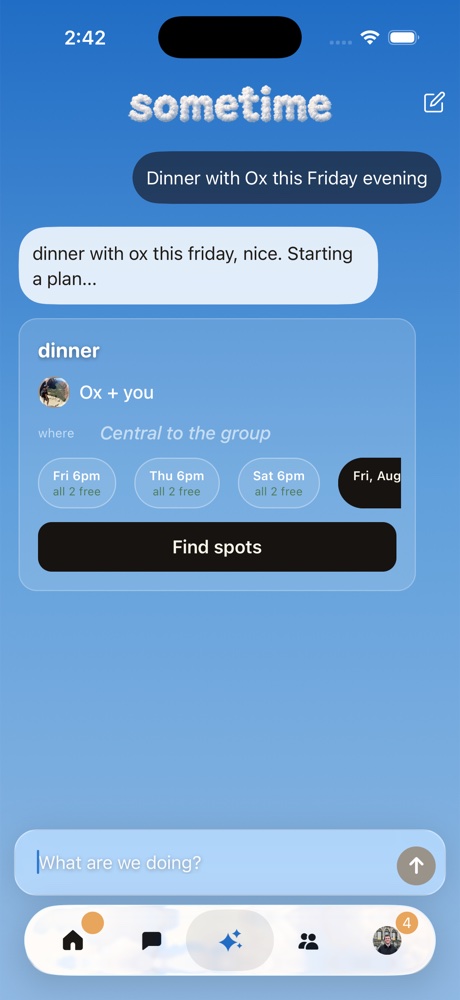
The lead moment: the agent turning "dinner with Ox this Friday" into a plan. What is happening here and why it matters.
How a plan flows end to end: ask, draft, invite, RSVP.
The overview: what happens from opening the app to standing somewhere with your people. The agent, the graph, the plan.
What these two figures mean in your words: the loop the product runs, and why the decision takes all four inputs at once.
intimate
The default unit: a few people, a time that works, a spot. How the agent drafts one.
large gatherings
Cover art, web invites, RSVP without the app. How a party spreads.
group identity
The weekly rhythm you belong to, and where new people enter your graph.
Suggested topic: intent beats availability. One tap of "I want to do something" is worth more than a shared calendar.
Suggested topic: the agent coordinates so people can connect. AI belongs in the logistics, never in the friendship.
Suggested topic: who and what together. Recommending a place is easy; recommending the place AND the people is the actual problem.
Suggested topic: events are social context. "Who from my circle is going" matters more than the listing.
Suggested topic: software with weather. Why the app lives under a real sky that tracks the sun.
Seven products in one app
covers, web invites, RSVP
a Partiful, a Lumagroups, media, reactions
a full chat appplans, venues, events
an AI social agentspaces, subgroups, event chats
a community platformthe graph, taste, memory
a context engineidentity, photos, people
a social profilewindows, blocks, availability
a calendarThe scope, in your words: what it meant to build all seven at once, and why the app needed every one of them.
A paragraph on how you actually built this: your process, the agents, what the numbers above mean to you.
May 2026
Left Dodge and Cox. One line on the bet you were making.
Summer
Split time: expert equity-research data labeling to fund it, Sometime the rest. What grading models taught you.
The tangent
The AI safety detour, and why it made you better at driving agents.
Sometime
What building all of this solo taught you. The big takeaway.
Now
Where you're pointed, and why.